
The decline in organic traffic in 2026 is complex. To answer why your specific domain is losing organic traffic, there are five distinct problems to address. Google algorithm shifts, AI Overview cannibalization, LLM answer displacement, technical debt, and content quality collapse each require a different diagnosis and a different fix. This post walks through how to identify challenges using your own GA4 and Search Console data.
“Organic traffic is down” is not a diagnosis
The core challenge in 2026 is that the traditional analytics stack shows you that something happened but doesn’t identify why. When traffic drops, the instinct is to look for a cause where the measurement lives. However, solving the wrong problem wastes months and may not help. A content team that publishes 40 more posts to recover from an AI Overview cannibalization problem is working hard in the wrong direction. A CMO who escalates to a technical SEO audit when the real issue is LLM displacement won’t find anything wrong because nothing is wrong where they’re looking.
GA4 organic sessions, Search Console clicks, and average position each capture part of the picture. The part they can’t show you is the demand that bypasses search entirely and goes straight into ChatGPT or Perplexity. LLM search is growing as a share of total buyer research activity, yet it leaves no trace in any dashboard that most marketing teams currently run.
Before you can determine what to fix, you need to know the cause of the drop in your domain traffic.
Cause 1: Google algorithm impact
This is the most familiar cause and, importantly, not the dominant one for most SaaS sites that have maintained reasonable content quality. But it’s worth separating cleanly because it gets conflated with the causes that follow.
Google’s Helpful Content System updates, combined with the major core updates in 2024 and into 2025, most significantly affected sites publishing thin content at scale, content without clear E-E-A-T signals, and sites that saw outsized traffic gains from AI-generated content between 2022 and 2023. If your site fits one of those profiles and you haven’t addressed it, algorithm impact is likely a contributing factor.
Diagnostic signal
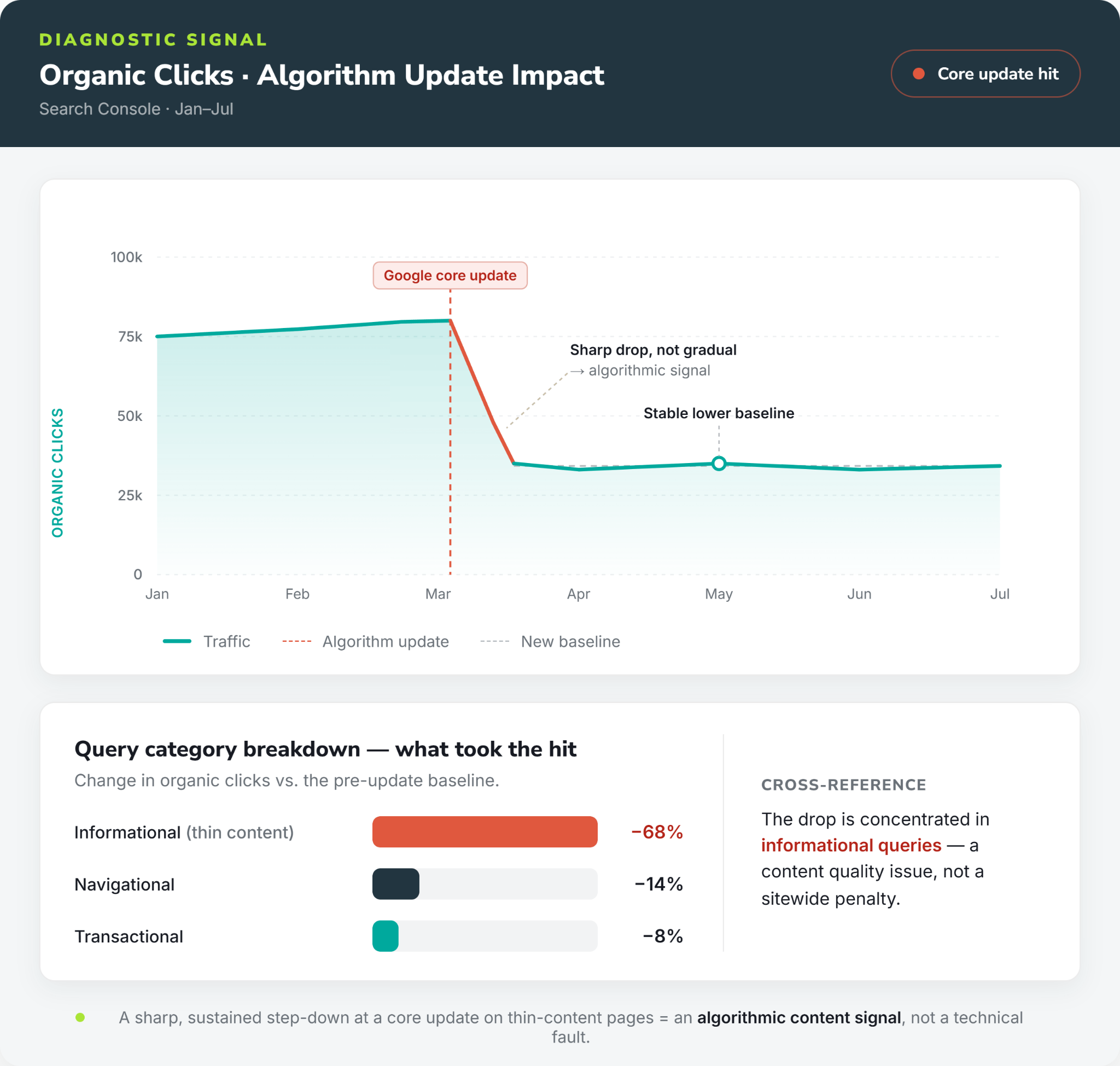
Pull your Search Console performance data and filter by date ranges that bracket known Google algorithm update dates. If traffic dropped sharply and stabilized at a new lower baseline, rather than following a gradual slope, and that correlates with a confirmed update date, it points to algorithm impact as the primary driver. Cross-reference this against which query categories took the hit. If it’s concentrated in informational queries on topics where your content is thin, that’s likely the issue.
How To Address an Algorithmic Issue
Focus on content quality remediation, not volume. The sites that recovered from these updates consolidated weak pages, added genuine author expertise signals, and invested depth into fewer, better articles. Publishing more doesn’t fix this traffic drop. It compounds it.
Cause 2: AI Overview cannibalization
AI overview cannibalization is easily misunderstood as a rankings problem.
Google’s AI Overviews now appear for a substantial share of informational and navigational queries, including a significant portion of the B2B research queries that SaaS marketing teams have historically depended on for top-of-funnel traffic. When an AI Overview answers the question completely above the fold, the pages ranking organically below it receive meaningfully fewer clicks than they did before AI Overviews existed for that query.
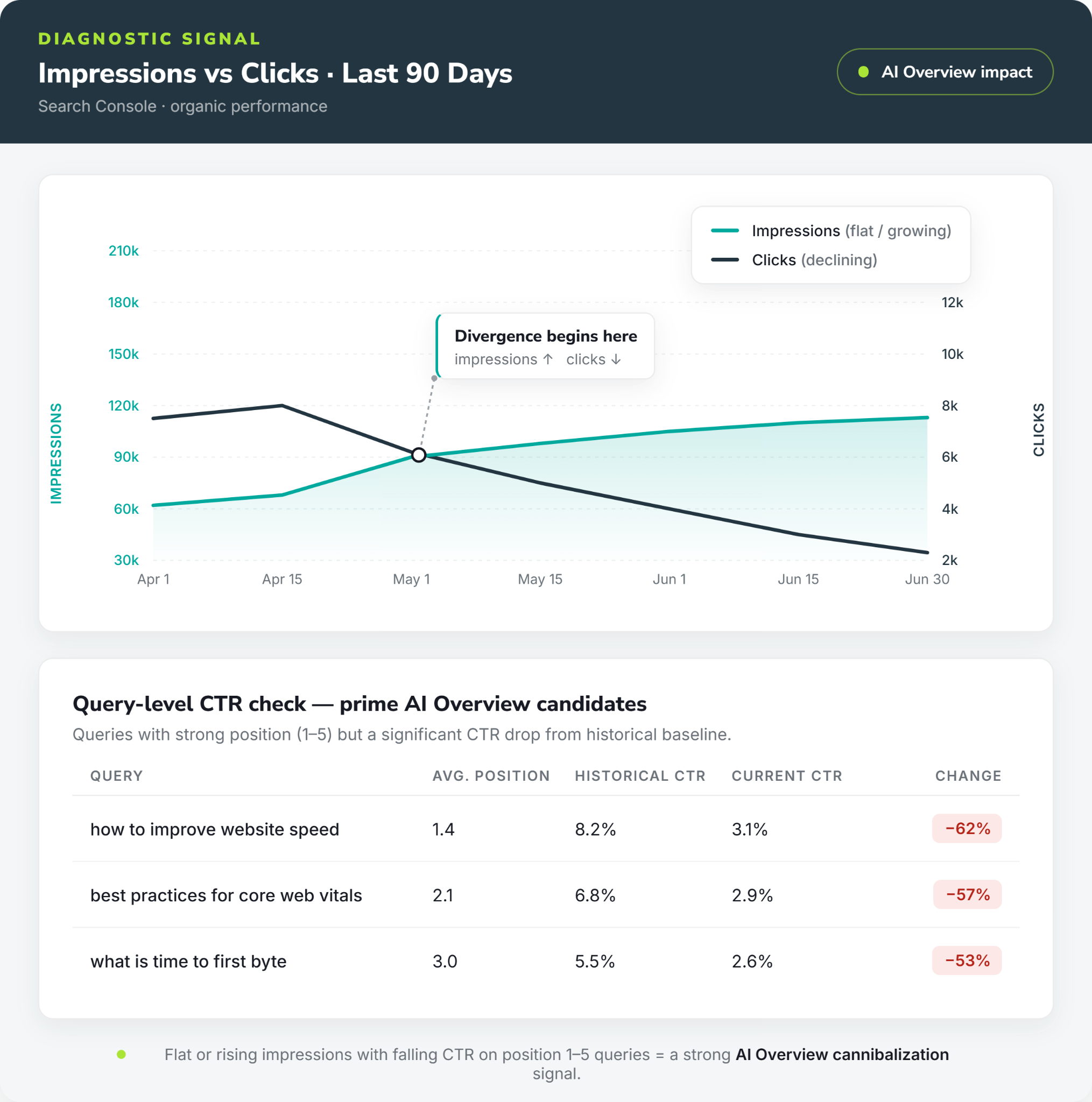
The result in your analytics will show that rankings hold, impressions hold or grow, and clicks fall. Average position improves in some cases because you’re still ranking for the query — you’re just not getting the traffic you used to from that position.
Diagnostic signal
This pattern is identifiable in Search Console. Filter your top pages by the last 90 days and compare impressions versus clicks on a trend basis. If impressions are flat or growing while clicks are declining for the same queries, AI Overview cannibalization is the most likely explanation. You can also check this at the query level, focusing on queries where your average position is strong (1–5) but CTR has dropped significantly relative to historical baselines; these are prime candidates.
How to address AI Overview cannibalization
Focus on structural content changes designed to earn inclusion inside AI Overviews, not just ranking below them. Answer-first formatting, schema markup, entity clarity, and concise direct-answer sections increase the probability that your content is the source Google’s AI Overview cites. This is a different problem from traditional ranking optimization — the goal shifts from “rank at the top” to “be the cited source in the answer that replaces the click.”
Cause 3: LLM answer displacement
LLM answer displacement is the cause that doesn’t show up in your analytics, and it’s the issue most likely to be overlooked in your current diagnostic.
ChatGPT, Perplexity, Gemini, and Claude are answering a growing share of the buyer research queries that used to flow through Google:
- “Best [category] tools for [use case]”
- “Alternatives to [incumbent]”
- “[tool A] vs [tool B]”
These are exactly the prompts your buyers are running, and they’re running them directly inside AI assistants, not in a search bar. When an LLM answers those queries, it doesn’t send a referral click to anyone. The demand existed; an answer is given, possibly using your content, but it never entered the channel you’re measuring.
For B2B SaaS specifically, this is a structural risk. Your buyers are highly AI-tool-literate. They use ChatGPT and Perplexity for vendor research, competitive comparison, and category shortlisting. If your brand isn’t cited in the answers these models produce, you’re not losing rankings; you’re losing consideration at the stage before the buyer ever gets to a search engine.
Diagnostic signal
Start in GA4 under Traffic Acquisition and filter for referral sessions from chatgpt.com, perplexity.ai, claude.ai, and gemini.google.com. If those sources appear, LLM displacement is active, and you have a baseline to measure against. If they don’t appear, that’s not confirmation the problem doesn’t exist; it means GA4 isn’t capturing it yet. LLM displacement shows up as demand that never entered your analytics in the first place, which is precisely what makes it easy to undercount.
The more rigorous diagnostic is a prompt-level brand mention audit. To complete this, run the queries your buyers would use in ChatGPT, Perplexity, and Gemini, and observe whether your brand is cited, how often, and in what context. Compare that against competitors in your category. The gap you find there is the real number, not the one in GA4.
How to address LLM answer displacement
Implement GEO (Generative Engine Optimization) and AEO (Answer Engine Optimization) strategy. This means building content that is machine-readable and citation-worthy. It includes entity optimization, structured content that LLMs can extract cleanly, and a deliberate presence across the third-party sources that models use for training and retrieval inputs. Traditional link building doesn’t move this needle. Citation architecture does.
Cause 4: Technical SEO degradation
This cause is well understood but worth keeping on the diagnostic checklist, particularly for SaaS sites that ship product updates frequently and treat the marketing site as a lower-engineering-priority surface.
Indexation problems, Core Web Vitals regressions, crawl budget waste from product-driven URL proliferation, and JavaScript rendering issues accumulate silently. They don’t announce themselves. A site that shipped 200 new product-feature pages in the last 18 months may have diluted crawl budget on the pages that drive organic traffic, without anyone on the marketing team flagging it.
Diagnostic signal
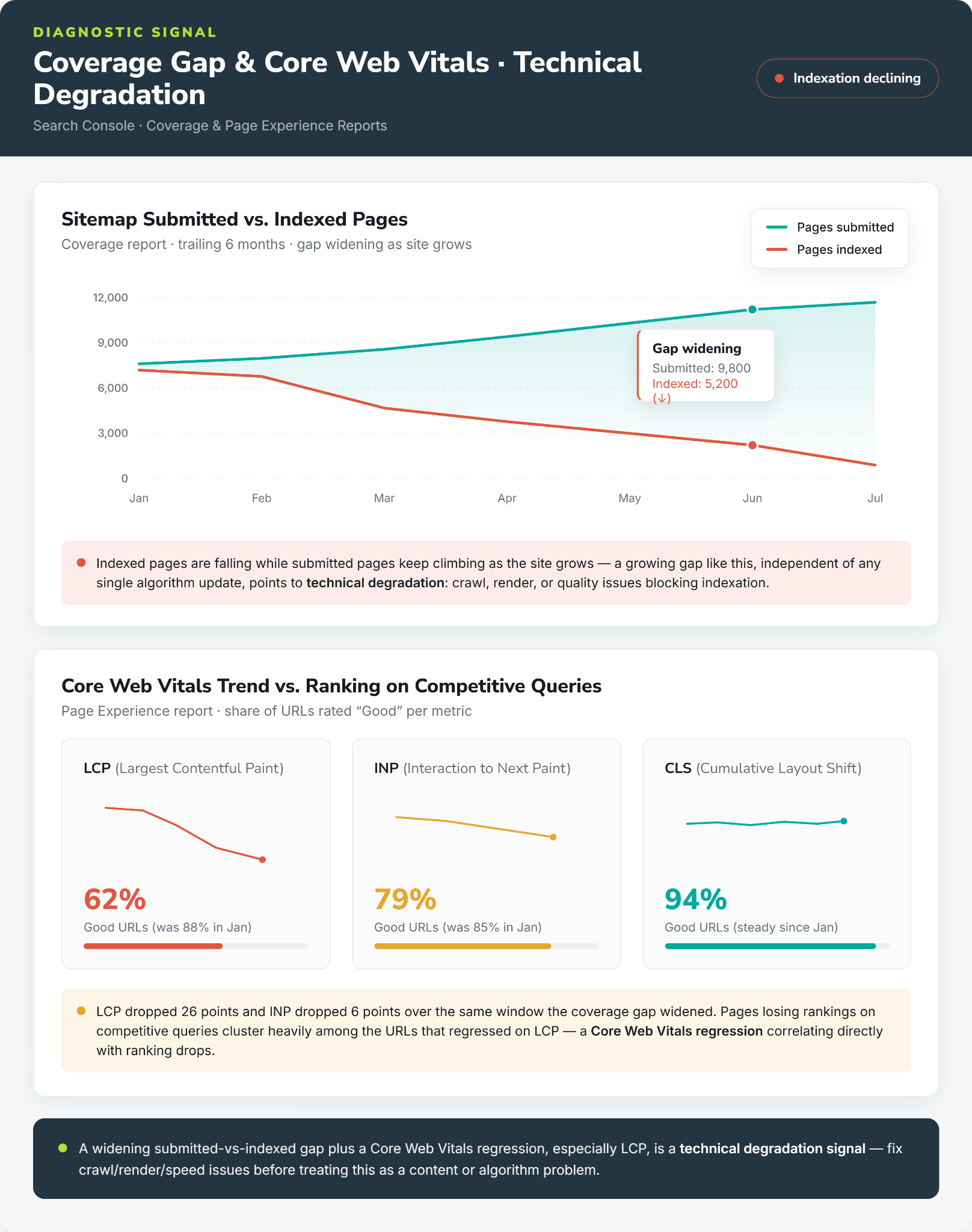
Compare the number of sitemap pages you submitted to the number of indexed pages in Google Search Console’s Coverage report. A growing gap between pages submitted and pages indexed, combined with a declining indexed page count while your actual site grows, points to technical degradation. Also, check your Core Web Vitals trend in Search Console’s Page Experience report. Regressions here correlate with drops in rankings on competitive queries.
How to address technical SEO degradation
A technical SEO audit prioritizes traffic-bearing pages, not total page count. Fix crawl efficiency before adding content. Rendering issues on JavaScript-heavy product pages should be evaluated against their traffic contribution.
Cause 5: Content quality collapse
Poor content is the most common self-inflicted reason for traffic decline we see on B2B websites.
2023 and 2024 saw widespread adoption of AI-assisted content publishing at scale. The hypothesis was sound. Companies assumed that producing more content and covering more queries would result in capturing more traffic.
The problem with this theory is that volume without topical authority, editorial depth, and genuine expertise signals doesn’t build an organic presence. It dilutes one.
Google’s quality systems caught up and adapted to this strategy. Sites carrying hundreds of thin pages are watching weak content suppress the authority of the pages that actually deserve to rank. The symptom appears as a broad-based traffic decline across many pages simultaneously, with no clear correlation to algorithm updates and no technical explanation.
Diagnostic signal
Run a content audit sorted by organic traffic per page over the last 90 days. If the bottom 40–50% of your published pages are generating fewer than 10 organic sessions per month each, and those pages collectively outnumber your performing pages, you have a content quality problem. Look especially for pages targeting keywords where your site has not demonstrated topical authority. You can identify these topics by checking whether the top-ranking pages for those queries are from sites with years of depth on the topic, while yours is a single post with no supporting content cluster.
How to address improving content quality
Start with a consolidation strategy, not continued publishing. Merge overlapping content into single authoritative pages, 301 redirect the rest, and remove pages that cannot be rehabilitated. Then invest in depth and highlight real practitioner expertise, case study integration, and original data where possible.
Read: How to optimize your site for AI search
The diagnostic sequence
Most sites in 2026 are dealing with more than one of these issues simultaneously. The sequence of repair matters because some fixes create preconditions for others.
Step 1 — Check Search Console: impressions vs. clicks trend. If impressions are flat or growing while clicks are declining, AI Overview cannibalization (Cause 2) is the primary driver. Confirm by checking CTR decline on queries where your position is strong.
Step 2 — Check for step-function drops against algorithm update dates. If the decline correlates with a confirmed Google core update date and is concentrated in informational queries, algorithm impact (Cause 1) is a contributing factor. Check Google Search Central Blog for confirmed update dates.
Step 3 — Check GA4 for AI platform referral traffic. Look for traffic from chatgpt.com, perplexity.ai, claude.ai, and gemini.google.com. If present but small relative to your organic traffic, LLM displacement (Cause 3) is active. If absent, run manual prompt audits in ChatGPT and Perplexity for your primary category queries before concluding otherwise.
Step 4 — Check indexed page count against published page count. If there’s a significant and growing gap, start a technical SEO investigation (Cause 4). Prioritize by traffic-bearing page segments, not total site coverage.
Step 5 — Run a content performance distribution audit. If a large share of your published pages generate negligible organic traffic and lack topical depth, content quality collapse (Cause 5) is compounding your other issues.
What each cause requires — and what it doesn’t
| Cause | What it requires | What it doesn’t require |
| Algorithm impact | Content quality remediation, E-E-A-T signals, author attribution | More content volume |
| AI Overview cannibalization | Answer-first structure, schema, entity clarity | Higher traditional rankings |
| LLM displacement | GEO/AEO infrastructure, citation-worthy content, third-party presence | Traditional link building |
| Technical degradation | Crawl/index audit, rendering fixes, Core Web Vitals remediation | New content |
| Content quality collapse | Consolidation, removal, and depth investment on authority topics | Continued publishing |
The deeper question
Most CMOs aren’t just trying to figure out why traffic is down. They’re trying to explain the data to someone like a CEO, a board, or a finance partner who wants to know whether organic is a reliable channel or a variable one.
The honest answer in 2026 is that organic traffic is now a composite of traditional search performance and AI-mediated visibility, yet most reporting setups today measure only the former.
A declining GA4 organic number could mean many different things. It could reveal that your rankings dropped. However, it could also indicate that your rankings held, but AI Overviews ate your clicks. It’s possible your buyers shifted research activity to AI assistants entirely, and they’re missing your brand. Your site may have accumulated technical debt, or your content is actively working against you. Those are five different conversations, each requiring a different response. Finding the answer is possible, but it will take time to identify and address.
The CMO who can isolate the cause can scope the fix, accurately size the investment, and clearly explain the data. The one who can’t will keep optimizing the wrong variable while the real problem compounds.
That starts with knowing which traffic you actually lost — and which you never had a chance to capture in the first place.
Check your AI brand visibility
Use our free GEO Grader to see how ChatGPT, Perplexity, and Google AI Overviews represent your brand right now