
Most educational institutions know they need digital marketing. Fewer know where to start.
Meanwhile, prospective students are researching, comparing, and forming opinions about your institution before they ever contact admissions.
What they find online, or do not find, shapes their decision.
Why does digital marketing matter for higher education?
Digital marketing connects your institution to prospective students at the exact moment they are looking for what you offer.
According to research by Search Influence and UPCEA, 84% of prospective students use search engines to research programs, and 79% read Google’s AI Overviews to learn more about colleges and universities.
If your institution doesn’t show up where students search, you won’t make the list.
In higher education, the gap between awareness and action is where enrollment opportunities are lost. More than three-fourths of higher ed marketers view SEO as a core part of their marketing strategy, yet only about half have an established strategy.
Digital marketing gives smaller colleges and universities the tools to:
- Reach prospective students where they already spend time
- Build trust through consistent, helpful content
- Compete with larger institutions without a massive budget
Small teams can be stretched too thin. If you have limited resources, staff, and budget, you’ll need to focus your efforts to maximize your impact.
Traditional education marketing vs digital marketing
Traditional education marketing methods are not obsolete. Still, print ads, direct mail, and college fairs work differently than they used to, and they rarely work alone.
Traditional marketing pushes information out to a broad audience, hoping the right students see it. However, it’s expensive, and results are hard to measure.
Digital marketing meets students in their search. Pew Research indicates that 96% of high school-aged students use the internet daily.
So digital marketing draws interested students to your institution by answering their questions with helpful content. They’ll learn about your institution before they request information.
Many smaller institutions find value in using traditional touchpoints to reinforce a digital-first strategy, but the best education marketing strategies build a digital foundation.
What is the student search journey in higher ed?
The student search journey shows how prospective students move from thinking about college to applying for college.
It has three stages: awareness, consideration, and decision. Your institution needs to show up at each one.
According to EAB research, 80% of prospective students are considered “stealth” —unknown to institutions — until they apply. They research, compare options, and form opinions about your institution early.
The student search journey generally follows this path:
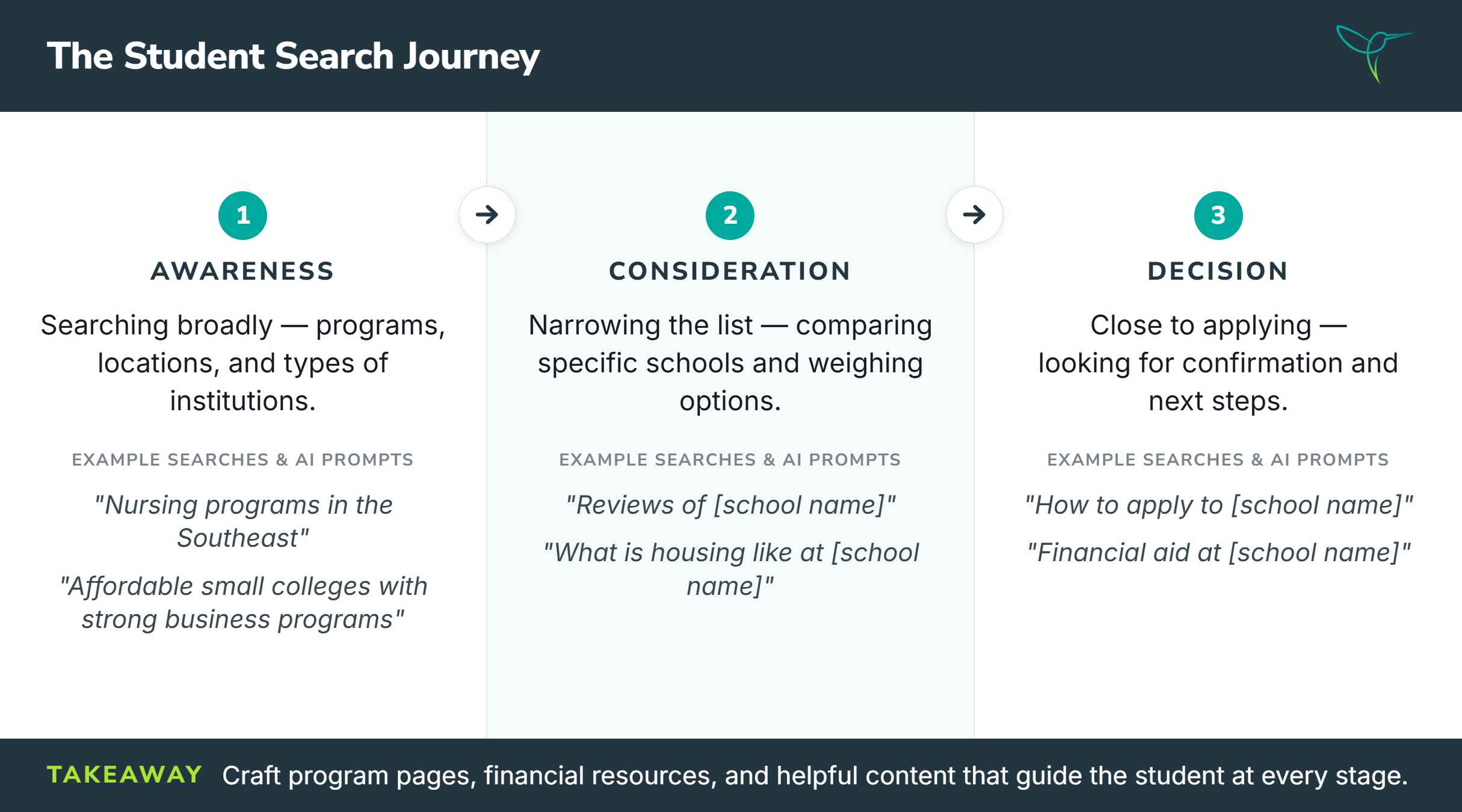
1. Awareness
A student begins searching broadly. They look for programs, locations, and types of institutions.
Example search queries or AI prompts:
- “Nursing programs in the Southeast”
- “affordable small colleges with strong business programs”
- “two-year degrees with good job placement”
2. Consideration
A student narrows their list. They start looking at specific schools and comparing options.
Example search queries or AI prompts:
- “Reviews of [school name]”
- “What is housing like at [school name]?”
- “Is [school name] accredited?”
- “Class size at [school name]”
3. Decision
A student is close to applying. They are looking for confirmation and next steps.
Example search queries or AI prompts:
- “How to apply to [school name]”
- “Financial aid at [school name]”
- “[School name] application deadline”
- “Scholarships for incoming freshmen at [school name]”
Craft program pages, financial resources, and helpful content that guide the student at each stage.
How is AI search changing digital marketing for higher ed?
AI search skips the list of organic links and delivers an individualized, direct answer. If your institution is not found in the AI-synthesized results, you are not in the running, no matter how much you spend or where you show up offline.
For example, A student who asks ChatGPT, “What are good small colleges for environmental science in the Pacific Northwest?” will get a curated response. That student will read through the recommended institutions and then possibly conduct a direct search for one or two that catch their attention.
That means you need a strategy that optimizes your content to show up in both traditional search results and AI-generated responses.
Step 1: Build your SEO foundation
Search Engine Optimization (SEO) makes your website easier for search engines to find, understand, and rank.
For smaller institutions, strong SEO is one of the highest-return investments available: it drives traffic without paying for every click.
Before anything else, your website needs to be technically sound.
Technical SEO basics:
- Fast load times, especially on mobile
- Clean site structure with program pages easy to find
- No broken links or crawl errors
- Secure site (HTTPS)
- Accurate, consistent contact and location information
High-quality content:
Create content that answers the questions students search for: by program name, location, and outcome (“the best nursing program in Ohio”). Program pages should be specific, complete, and written in plain language.
Explain what a graduate can do, not just what the degree is called.
Keyword categories worth targeting:
- Program-specific searches (“respiratory therapy programs in Ohio”)
- Financing searches (“colleges with the best financial aid packages”)
- Location-based searches (“small colleges near Nashville”)
- Comparison searches (“community college vs. four-year university”)
Tools like SE Ranking can help you track where your pages rank, identify gaps, and monitor how competitors show up in search.
Step 2: Optimize for AI search with GEO
Generative engine optimization (GEO) is the practice of structuring your content so that AI-powered tools like Google AI Overviews, ChatGPT, and Perplexity can accurately understand and surface your institution in their responses.
This matters more than many institutions realize. If your content is not structured for AI to read, your institution may not show up in those responses at all. In 2025, 46% of students reported using AI tools such as ChatGPT in their college search.
GEO best practices for colleges:
- Use clear, definitive language (“Our nursing program is a four-year BSN…”)
- Structure FAQ sections that directly answer common student questions
- Keep program information, tuition, and admissions details current and accurate
- Use structured data markup so search engines understand your content
- Build content around specific, answerable questions students are asking AI tools
GEO and SEO are not separate strategies; they work together.
SEO helps search engines surface your content. GEO ensures AI tools represent your institution when students ask direct questions.
Step 3: Build your digital marketing strategy
With an SEO + GEO foundation, you can focus on strategies like paid search, email, and social media.
PPC and paid search through Google Ads help you show up for competitive keywords while organic rankings are still building. For smaller institutions with limited budgets, targeting long-tail, program-specific keywords keeps costs manageable.
Email marketing remains one of the most effective ways to keep prospective students engaged from first inquiry through enrollment. A welcome email triggered by a form submission, followed by program-specific follow-ups, can make a real difference in how many inquiries become applicants.
Students use Instagram and TikTok to search, not just scroll. A strong presence on social media builds brand awareness and trust simultaneously. Content from real students is more credible than anything your marketing team produces on its own.
The key is sequencing your strategy.
Paid ads on top of a weak website will not convert.
Social content without SEO is hard to sustain.
Each layer supports the next.
Transparency: Update your AI policy
Your institution likely has an AI policy for academic use that governs how students and faculty use AI tools in coursework.
There is a separate consideration for your marketing and communications: how is AI being used to create your content, and are you being transparent about it?
Authenticity is one of the top factors students say influences their decision-making.
If your blog posts, social captions, or email campaigns feel generic or AI-produced, it can undermine trust in your institution.
A published, clear AI policy signals to both prospective students and AI systems that your institution is thoughtful and trustworthy.
A few things to address in or alongside your AI policy:
- How AI is used (or not used) in your marketing content
- How do you ensure information about your institution is accurate in AI-generated search results
- How prospective students can get verified, up-to-date information directly from your team
This does not need to be a lengthy document. A simple, honest page or section on your website goes a long way.
Who is Gen Alpha and how should colleges market to them?
Gen Alpha is the generation currently in middle school and early high school. They are still four or more years away from seriously searching for colleges, which means that this is the right time to position your institution for their search.
A few things that define Gen Alpha:
- They have never known a world without smartphones, social media, or AI assistants
- They use platforms like YouTube and TikTok to search, learn, and discover
- Voice search is second nature (Siri, Hey Google, Alexa…)
- Their parents are primarily Millennials who are digitally fluent and deeply involved in their children’s education
- They expect personalized, relevant experiences from the brands and institutions they engage with
The institutions that will most effectively recruit Gen Alpha are those building a strong digital foundation now.
That means a fast, well-structured website, content that shows up in search results and AI-generated responses, and authentic student stories on the platforms where they already spend time.
By the time Gen Alpha starts searching for colleges, they will expect a seamless digital experience, accurate AI search results, and content that feels real.
How to get started with higher education digital marketing
Start with an honest assessment of where your institution stands today. Before investing in paid ads or social media campaigns, audit what you already have.
- Is your website fast, mobile-friendly, and easy to navigate?
- Do your program pages answer the questions students are actually searching for?
- Is your institution showing up in search results and AI responses for the programs you offer?
If the answer to any of those questions is no, that’s where you should begin.
A strong digital foundation makes every other marketing effort more effective. For smaller institutions with lean teams, the goal is not to do everything at once. Simply do the right things in the right order.
SMA Marketing works with colleges and universities to develop digital marketing strategies that drive enrollment growth. If you are ready to build a stronger digital presence, let’s talk.